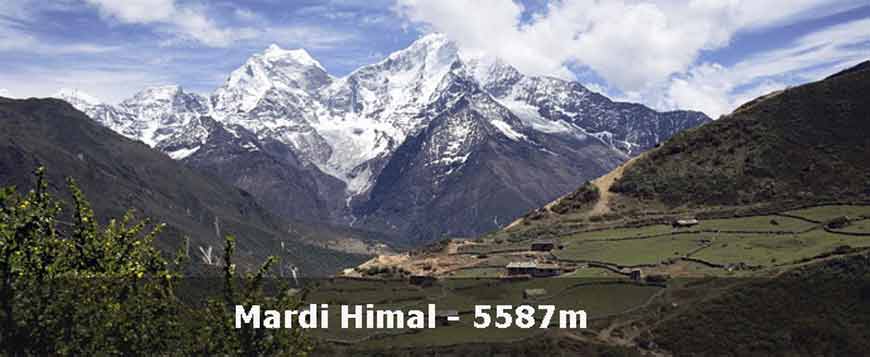
Mardi Himal Peak - 5587m
Mardi Himal (5,587 m) lies less than 15 miles from Pokhara, and is the most southerly peak of the Annapurna range. It is the lowest and the least climbed or visited peak. Photographs of Mardi Himal taken in 1953 by Baisl Goodfellow first drew the attention of western climbers, and the mountain received its first ascent in 1961. The first route was via the East Flank and is the only one used so far. The mountain separates the southwest ridge of Machhapuchhare as a separate mass at right angles to the ridge and is best seen from the south. The southwest face of the mountain has three well-defined ridges rising from rock buttresses and separated by hanging glaciers. Its east face is separated from the Machhapuchhare ridge by a col at 5,200 meters. The normal climbing route to the summit of Mardi Himal passes through this col. the summit offers a splendid view of the Annapurna Range and the Fishtail Mountain - Machhapuchhare
 Suggested Peak Climbing Itinerary:
Elevation: 5587m/18325ft.
Region: Annpurna Himal, Gandaki
The route: Kathamndu-Pokhara-Milan Chowk (Hemja)
Best Season: Sept. to Nov.& April to May.
Facility: Camping only
Program duration: 18 day Itinerary | Kathmandu
Day 01: Arrival Kathamndu & transfer to hotel.
Day 02: Preparation day / sightseeing
Day 03: Drive or fly to Pokhara & transfer to hotel.
Trekking
Day 04-08: Trek to Mardi Himal Base Camp
Climbing
Day 09-13; Set up Base Camp I, II, High Camp & Climb attempt
Day 14: Base Camp II
Day 14-18 Trek back to Pokhara Cost includes
Arrival and departure transportation, 3-meals a day during trekking, Camping gear (two-man tent, foam mattress, kitchen tent, dining tent and toilet tent) Supporting field staff including professional climbing guide, cook, kitchen boy, porters as well as their necessary insurance, meals and allowances Peak permit fee and Domestic airfare including airport tax, conservation and national park area entrance permit and first aid service. Cost excludes
Hotels in Kathmandu, International departure airport tax, Personal Insurance, Personal equipments - sleeping bag, down jacket, waterproof jacket, kit bag etc. Equipment allowance (Legally each expedition must be providing equipment allowance for all Sherpa, guides and porters. This allowance is necessary for brand new equipment (sleeping bag, shoes, crampons, down jacket, raincoat etc.). Travel medical insurance and emergency evacuation cost, laundry, telephone calls, alcoholic beverages, bottled drinks, tips, gifts, souvenirs, etc. Peak Climbing Information:
Nepal Mountaineering Association (NMA) has categorized 33 climbing peaks 2 different groups ‘A’ and ‘B’ which are given below. Please check the related fee accordingly.In exercise of the powers conferred by Nepal Government (NPG). Nepal Mountaineering Association (NMA) has made the following rules to be observed for the climbing of the peaks of Nepal Himalaya as listed in Appendix "1" These rules will come force at once. Definition:
Where applicable definitions for these rules will be the same as those for Nepal Government, Mountaineering Expedition Regulations 1979 and its first Amendment 1984. Permission:
Any person or Mountaineering team desirous of climbing the peak listed in Appendix "1" must receive permission from Nepal Mountaineering Association. Application to climb the peak must be made in the form as prescribed in Appendix "2"
Permission may be climb the peaks will be granted for a period of one month only.
Permission may be extended, if necessary, for another period of two weeks.
The period of permission granted relates to time spent for climbing above the base camp. The trek to and from the base camp is not included.
Application for climbing permit may be made at any time by the concerned Mountaineering team. Permit will be granted on a first come first serve basis.
Each climbing party will be given a permit as prescribed in Appendix "3". The right permission to another party for climbing the same peak during the same period is reserved by Nepal Mountaineering Association.
Nepal Mountaineering Association will recommend to Immigration Office of Nepal Government for obtaining trekking permit of the area to the team Members. Group Size Climbing Fee US$ Additional Persons / Maximum number of members in one team is 12.
1-4 Persons US$ 350.00 N.A.
5-8 Persons US$ 350.00 US$ 40.00 Per Person
9-12 Persons US$ 510.00 US$ 25.00 Per Person
Garbage Deposit for all 33 NMA Peaks:
A Garbage Deposit fee of USD 250.00 payable to NMA is required to obtain permits for all 33 NMA peaks. Refunds on the Garbage Deposit shall be as per NMA provisions. Protection of Environments:
Base camp and other camps will be left perfectly clean at the conclusion of the climb. No foreign materials such as fix ropes, pitons etc. shall be left on the mountain. All rubbish and waste material must be burnt or otherwise disposed off. Insurance:
All employees going above base camp must be insured for personal accident to the value of NRs. 5,00,000/- (Amended 1999) For More information
Drop mail: holidaynepal@gmail.com | WhatsApp +977 9841 911150