Kali Gandaki River Rafting
The Kaligandaki, named after the goddess Kali and probably the bet Medium length white water journey, rises in Mustang, close to the Tibet border. As it tumbles between the Dhaulagiri and Annapurna range, it creates the World's deepest river gorge. It is an ancient trading route through to Tibet and now is also a popular trekking trail, The beautiful un-spoilt river offers, unique views of the Annapurna range, elusive wildlife, charming villages. thick and fat froth white water and deserted beach
 Tentative Plan
7.30 am: Reporting Time
8.00 am: Departure from Lakeside, Pokhara
Pre Departure Briefing:
The day before the departure date we meet the group at our Pokhara office to answer your question. You will be told where to meet for departure and details of the trips.
Day 01: Pokhara to Naya Pool
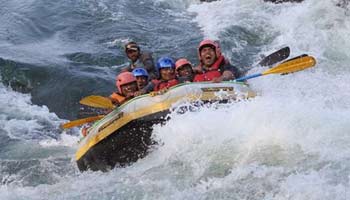
At around 8:00 A.M. we drive to the put in point at Nayapul. Throughout the drive we have wonderful view of the Annapurna and Dhaulagiri ranges as well a the Sacred Machhapuchhre. Upon arrival, we unload the gear, set up the rafts and after lunch you will have an extensive fracture of safety briefing and demonstrate you the padding technique by the Trip Leader. We meet the first class IV rapid in the first twenty minutes of being on the water, when out guides give you a confidence how they command in adventure with attitude. Safety Kayakers always lead the way as being a safety expert. The first rapids we run are "LITTLE BROTHER, BIG BROTHER, CAVE AND DAM" After crossing the Modi confluence we sep up the camp. We unload the gears and prepare dinner while you can play volleyball or experience and Adventure with music on enjoy the scenery. (Rafting 2-3 hours depends on volume and gradient of the river) Day 02: Continue Rafting
After breakfast ones the rafts are loaded we raft down to the river for a day with many class III & IV rapids. Like "EVIL REFUND, BLACK ROCK, LANDSLIDES" as well the views of the Annapurna I the Himchuli. The river is flowing by hanging from the cliff faces and gorge. Our camp site just below the village of Purti Ghat (Rafting Approx. 4-5 hours depend up on the volume and gradient of the river) Day 03: Continue Rafting & To Pokhara:
This section of the river also offers some white water with class III rapids. As we explore on the river we reach the small village of Seti Beni. We will have couple of hours rafting till we end the trip after lunch. Our private bus will take us back to Pokhara by early evening. Including:
Transportation, Accommodation Tented Camp, Breakfast, Lunch, Dinner + Paddle, Life Jacket, Helmet, Safety Barrel etc. SAFETY:
- Safety is the most important part of any river trip. Choosing a professional veteran rafting guide is the first -step. So it helps to abide by the following tips:
- Pick your river with care. Seek information from river guide before raft. Literature on river levels and difficulty.
- There should be a minimum of two rafts per trip, So that one can help when a fall happens from the other.
- Carry first-aid kit, Survival and rescue gear.
- Check to see that end loops and the leash are adequate before you push off. This makes it easier to keep hold of your boat when swimming big rapids, and also in the event of rescue.
- Be a team person, paddle synchronously.
- For boats, paddles and helmets, loud colors are recommended.
- Wear life jackets and helmets, properly too
- Keep your feet and arms inside the raft at all time.
- When you fall off into a rapid, float on your back, with your feet downstream. What we provided::
All Rafting and Kayaking Equipment Waterproof bags for personal gears | Helmet Life Jacket | Paddle Transportation | Food Kayak & Raft Instructions | Camping and Cooking Equipments Waterproof Barrels & First aid kit What you need:
Sleeping Bag & Mat | T-Shirt & Shorts | River Sandal | Sun Tan Lotion-Lip Cream | Towel | Personal Toiletries | Water Bottle | Torch Light | Sun Glass | Camera (We have waterproof containers, | final responsibility is yours) | Half Pant | Sun Hats. River Classification of Difficulty:
Class: 1 Easy:
Moving water with occasional small rapid, few or no obstacles.
Class: 2 Moderate:
Small rapid with regular waves. Some maneuvering required but easy to native.
Class: 3 Difficult:
Rapids with irregular waves and hazards that need avoiding.More difficult maneuvering required but routes are normally obvious. Scouting from the shore is occasionally necessary.
Class: 4 Very Difficult:
Large rapid that require careful maneuvering. Dangerous hazards. Scouting from the shore is often necessary and rescue is usually difficult. kayakers should be able to roll. Turbulent water & large irregular waves may flip rafts. In the event of a mishap there is significant risk of loss, damage and/or injury.
Class: 5 Extremely difficult:
Continuous, powerful, confused water makes route finding difficult and scouting from the shore is essential.Precise manicuring is critical and for kayakers, rolling ability needs to be 100%. Rescue is very difficult or impossible and in the event of a mishap there is a significant hazard to life.
Class: 6 Nearly impossible:
Difficulties of class 6 carried to the extremely of navigability. Might possibly (but not probably) be run by a team of experts at the right water level in the right conditions with all possible safety precautions, but still with considerable hazard to life. Seasons:
October through mid-December and March through early May are the best times. It is possible in winter, but you have to watch out for hypothermia. During monsoon (June to September), the white water sections are dangerous, but gentler stretches are run-able. For More information
Write Us M@il to: holidaynepal@gmail.com | Contact Us: +977 9816 770 504 (WhatsApp) OR Hotline: +977 9841 911150
 Boudhanath Stupa
 Poon Hill Excursion
 Muktinath Temple
 Honeymoon Package
 Pashupatinath Darshan
 Australian Camp, Pokhara
 Fewa Lake, Pokhara
 Mayadevi Temple Lumbini
 EBC TREKKING