Welcome to Bhutan
Bhutan, a Buddhist Kingdom, lies along the lofty ridges of the eastern Himalayas, bordered by China (Tibet) to the north and northwest, and by the Indian states of Arunachal Pradesh, Assam, West Bengal and Sikkim on the East, South and West respectively. With an area of 46,500 Sq. km Bhutan is comparable to Switzerland both in its size and topography. It was the mighty Himalayas, which protected Bhutan from the rest of the world, and left the Kingdom blissfully untouched Bhutanese people are driven by their respect for the tantric strain of Mahayana Buddhism. The Bhutanese people have been able to protect this sacred heritage and unique identity for centuries by choosing to remain shrouded in a jealously guraded isolation. The population of the Kingdom is only about 6,00,000. Three main ethnic groups constitute Bhutan's population. the Sharchops, who are held to be earliest resident.
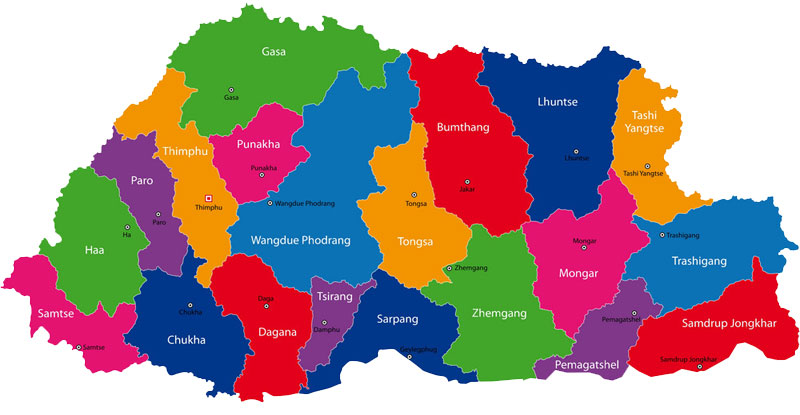 Bhutan Map
Bhutan Travel Tips:
Bhutan Map
Bhutan Travel Tips:All Foreign National Tourists visiting Bhutan must travel through all inclusive package Tours, for which there is a fixed tariff set by the Royal government of Bhutan. This Tariff includes the Services of accommodation, All meals, Transportation within the country, Guide services, sightseeing and entrance fees for the museums and monuments. Visa Information
All visitors to Bhutan must have a visa approved prior to arriving in the kingdom. Those who have not had a visa approved will not be permitted to board their Druk Air flight to Bhutan. A two-week visa costs US$40/- and actual visa stamping in your passport at Paro Airport during the immigration process. Visas are approved and issued prior to entry, with the prepayment of your travel itinerary. Therefore visitors to Bhutan need to finalize their travel plans well in advance. We recommend 30 days. How to process Bhutan Visa:
1: Send us clear passport photocopy (photo should be very clear & valid at least 6 months) of the clients 15-20 days prior to the travel date.
2: Except Indian, Bangladeshi & Maldives nationality, All tourist require a visa to entry the Bhutan. Bhutan tour operator or abroad co-parter travel agency will issue the travel visa for visitors.
3: For the Bhutan Visa Approval Letter process that you are transfer full payment of your holidays cost (including a USD $40 visa & Flight fee) through wire transferred and received in the Tourism Council of Bhutan bank account. Once received the visa clearance will be processed within 72 working hours.
Tourist Attractions:
Trashi Chhoe Dzong | Memorial Chorten | School of Arts and Crafts | Weekend market | Changlimithang Stadium | National Institute of Traditional Medicine | Taktsang (Tiger’s Nest) | Rimpung Dzong | Town of Paro Seasons
High Season: February, March, April, May, August, September, October, November and December
Low Season: January, June and July. Getting There
By Air: The best way to enter Bhutan is by Druk Air, the national air carrier. Following stations are connected with Druk Air Flight. BHUTAN FLIGHT SCHEDULE
DESTINATION: KATHMANDU TO PARO
DEPARTURE: 9.10 AM - EVERY MONDAY / WEDNESDAY & 13.50 PM (SATURDAY) DESTINATION: PARO TO KATHMANDU
DEPARTURE: 7.10 AM - EVERY MONDAY / WEDNESDAY & 11.50 AM (SATURDAY) Flight Fare:
Destination: KATHMANDU / PARO: USD 185+96: TOTAL USD 281.00
Destination: PARO / KATHMANDU: USD 200+60: TOTAL USD 260.00 Baggage allowance
For your kind information that Bhutan Airline baggage allowed while you are flying to Bhutan. Drukair allow you to carry 30kg baggage and 5 kg handbag while you are flying on economy class whereas there is bit more facilities on baggage for Business class costumers. It is 40 kg baggage and 7 kg handbag while you are flying to Bhutan on business class.
Travel Document Require:
Flight Tickets which issued by Druk Air Corporation or Bhutan Airlines
Minimum Six month valid Passport
Visa Approval Letter which issued by Bhutan Immigration Dept.
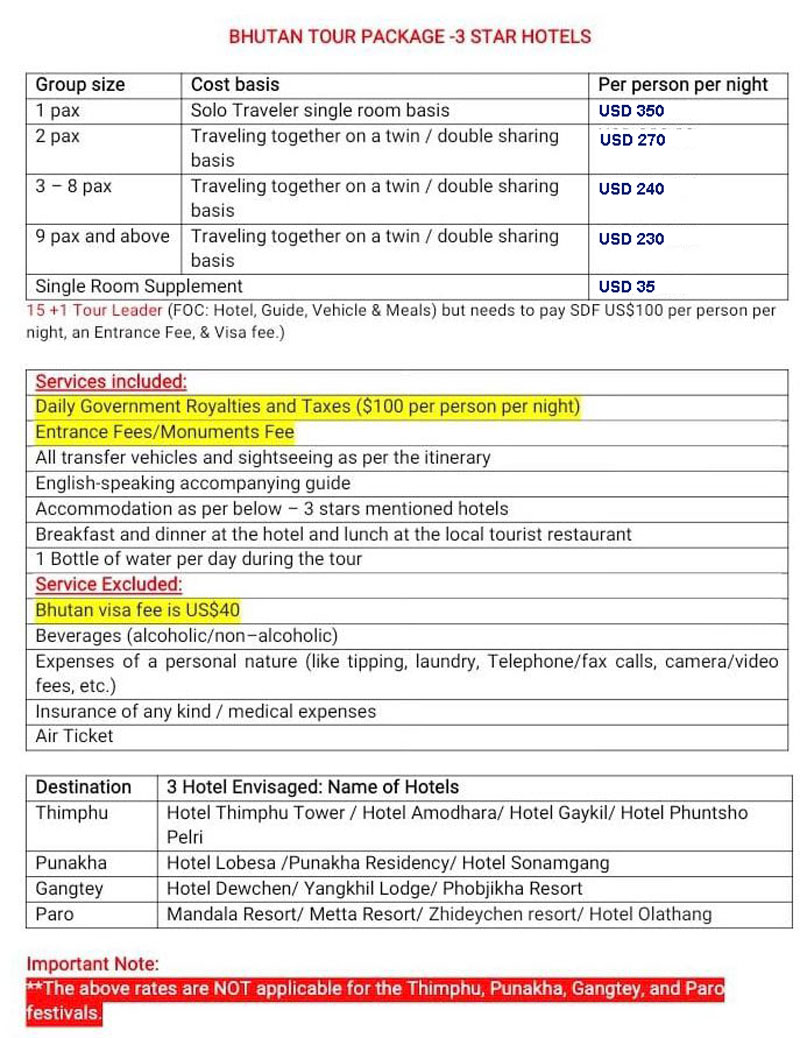 FLIGHT TICKETS: USD 541/- (KTM/PBH/KTM)
Mode of Payment
FLIGHT TICKETS: USD 541/- (KTM/PBH/KTM)
Mode of PaymentSince the Department of Tourism issues visa only upon receipt of full payment in advance, tour payment has to be transferred to our account at least 3 weeks before the travel date. Airfare needs to be sent at the time of issuing tickets. Tour Cost Includes: Ex Nepal Part
1. Private transportation By Tucson / Innova or land cruiser / Hiace/Coaster
2. All necessary travel and Trekking permits
3. English speaking Bhutanese guide.
4. Accommodation on single/twin room basis.
5. Sightseeing and monastery entrance fees as per the itinerary
6. Meal plan: Full Board Basis
7. Bhutanese Visa fee
8. Flight Fare : Kathmandu - Paro - Kathmandu (Round Trip) Tour Cost Excludes:
1. Insurance of any kind.
2. Additional cost due to natural calamity and unforeseen circumstance
3. Personal expenses such as drink, guide tips & etc. Note
By Surface: Entry or exit is also possible through Phuntsoling the southern Bhutanese border town. From here the nearest airport is Bagdogra in West Bengal. For travelers wishing to visit indian states of Sikkim, West Bengal along with Bhutan, Phuntsoling serves as the convenient point. Exit from Bhutan can be also made through Samdrup Jongkhar, an important link for visiting further Northeastern states of India. However, Government rules of Bhutan has made it mandatory to use at least one way by air. Important: Bhutan Tour Package have one single uniform rate per person/per day basis which is fixed by the Govt. of Bhutan. They do not have any Budget/Standard/Deluxe categories, using moderate hotels and all packages are on full board with sightseeing For More information:
Write Us Mail: holidaynepal@gmail.com | Call: +977 9841 911150 Or WhatsApp & Viber +977 9816 770504